 Skip Laurels: Popular Screening Trees in WNC
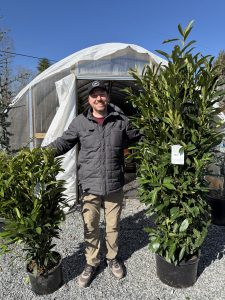
If you’ve been searching for a fast-growing, evergreen privacy screen that can handle the mountains of Western North Carolina, the Skip Laurel (Prunus laurocerasus ‘Schipkaensis’) deserves a top spot on your list. With its glossy dark green foliage, cold hardiness, and vigorous upright habit, it’s become one of the most popular screening plants in our region — and for good reason.
Why Skip Laurels Work So Well in WNC
Western North Carolina sits in USDA Hardiness Zones 6a–7b, and Skip Laurel thrives right in that sweet spot. Unlike many broadleaf evergreens that struggle with our occasional polar vortex winters, Skip Laurels are reliably cold-hardy down to around -10°F — meaning even a hard Asheville or Waynesville winter won’t wipe them out.
A few more reasons they excel here:
- Rapid growth: Expect 1.5 to 2 feet of growth per year under good conditions, quickly forming a dense, year-round visual barrier.
- Shade tolerance: Unlike many screening plants, Skip Laurels handle partial to moderate shade gracefully — perfect for the heavily wooded lots common in WNC.
- Deer resistance: The foliage contains compounds that deer generally find unpalatable, a significant advantage in our region where browsing pressure can be intense. Just remember, they aren’t deer proof!
- Low maintenance: Once established, they need minimal pruning and are reasonably drought-tolerant in our typically humid mountain climate.
Plant them 4–5 feet apart for a solid privacy hedge within 2–3 seasons, or give them more room and let them grow as large individual specimens reaching 10–18 feet tall and 5–7 feet wide.
So Why Are Your Skip Laurels Coming from Oregon?
If you’ve ever bought Skip Laurels from a local nursery and noticed the tags pointing back to a grower in the Pacific Northwest, you’re not imagining things — and there’s a very practical reason for it.
The wholesale nursery industry in the United States is heavily concentrated in Oregon’s Willamette Valley, which has become the production capital for containerized and balled-and-burlapped shrubs and trees shipped nationwide. The mild, wet winters and warm, dry summers of the Willamette Valley create near-ideal conditions for growing large quantities of consistent, high-quality nursery stock efficiently. Growers there benefit from rich volcanic soils, reliable irrigation from snowmelt, and a climate that allows for long, steady growing seasons without the stressful extremes of heat or cold.
But there’s a more specific reason Skip Laurels aren’t grown commercially in the Southeast: disease pressure.
In the hot, humid summers typical of the Carolinas, Georgia, and neighboring states, Skip Laurels are highly susceptible to bacterial shot hole disease (Xanthomonas arboricola) and various fungal leaf blights. These pathogens thrive in warm, wet conditions and can quickly defoliate plants, making it nearly impossible to grow clean, marketable nursery stock in a southeastern production setting. What looks lush and healthy coming off an Oregon truck may require careful site selection and good air circulation once it’s in the ground here — but at least the worst of the production-phase disease risk is behind it by the time it reaches your property.
Oregon’s dry summers essentially eliminate that problem at the production level, allowing growers to raise millions of Skip Laurels annually without the foliar disease losses that would make southeastern production economically unviable.
Tips for Planting Skip Laurels in the WNC Mountains
Getting your Skip Laurels off to a strong start will pay dividends for decades. Keep these regional tips in mind:
- Avoid wet feet: Our mountain soils can be heavy in clay-rich areas. Skip Laurels hate standing water — amend with soil conditioner nice and wide but not deeper than the pot to ensure good drainage before planting.
- Choose the right microclimate: They perform best with morning sun and a bit of afternoon shade. Full sun can work as well, but we would avoid planting them in full exposure on dry, windy ridges where they can get frost damage in winter. Think tucked away and around structures.
- Mulch well: A 3-inch layer of hardwood mulch helps moderate soil temperature, retain moisture, and suppress weeds — especially important in the first two summers.
- Air circulation matters: Give them room to breathe. Tight planting against structures with poor airflow can invite fungal issues that plague southeastern growers, particularly in shady areas.
- Water deeply in the first year: Even in WNC’s relatively humid climate, first-year establishment requires consistent moisture. Weekly deep watering during dry stretches is ideal. Mulching helps tremendously with this.
Skip Laurels vs. Arborvitae: Which Is Right for Your Property?
Arborvitae is the other screening plant most homeowners consider, and it’s worth understanding how the two compare before you plant a hundred feet of hedgerow.
Arborvitae (Thuja spp.) are popular for a reason — they’re fast, narrow, and inexpensive. But in WNC’s mountain climate, not all screening plants are created equal, and this is where many homeowners get surprised. Skip Laurels, despite their cold hardiness, are susceptible to winter burn — that frustrating browning of foliage caused by desiccating winter winds and freeze-thaw cycles. When the ground is frozen and the plant can’t take up water, exposed foliage dries out and browns, especially on south- and west-facing sites. At higher elevations or in open, wind-exposed locations, Skip Laurels can look rough by late February.
This is one area where two arborvitae stand out as particularly tough alternatives: Green Giant (Thuja standishii × plicata) and North Pole (Thuja occidentalis ‘Art Boe’). Green Giants are exceptionally cold-tolerant with impressive growth rates — often 3–5 feet per year in good conditions — and their needle-like foliage handles winter wind and frost without the browning issues that can plague broadleaf evergreens. North Pole is a tight, columnar selection that holds its color reliably through even hard WNC winters. Both are excellent choices for exposed, high-elevation, or wind-swept sites where winter burn on Skip Laurels would be a concern.
So how do Skip Laurels stack up against them overall? Here’s a quick comparison for WNC conditions:
- Winter burn risk: Skip Laurels can suffer winter burn on exposed sites, particularly above 3,000 feet or in open, wind-swept locations. Green Giants and North Poles hold their foliage color through harsh winters with far less risk of browning.
- Foliage texture and appearance: Skip Laurels offer broad, glossy, tropical-looking leaves — a bolder, denser visual screen. Arborvitae gives a finer, feathery texture that many find more traditional.
- Shade tolerance: Skip Laurels win here decisively. Arborvitae in general — including Green Giants — prefer full sun and thin out noticeably in partial shade. If your screening site has significant tree canopy, Skip Laurels are a safer choice, though North Pole is rated for good shade tolerance.
- Width and footprint: Skip Laurels stay relatively narrow for their height. Green Giants, while fast, can spread 12–15 feet wide at maturity, requiring more space. North Pole stays tight and columnar — a better fit for tight spaces.
- Deer pressure: Both are browsed by deer under high pressure, but Skip Laurels — with their bitter foliage — tend to be less of a target than arborvitae, which deer actively seek out in lean winters.
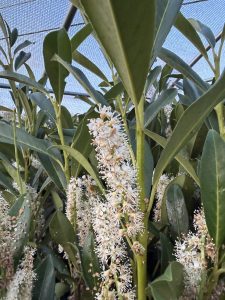
- Blooms! Skip laurels have fragrant white blooms in spring that the pollinators love, a clear bonus as an evergreen.
The honest recommendation: if your site is exposed, high-elevation, or consistently windy in winter, a Green Giant or North Pole arborvitae will give you a more reliably pristine look year-round. If your site has shade, wind protection, or you want a denser broadleaf screen, Skip Laurels planted in a sheltered spot are likely the better investment. The key is matching the plant to the microclimate — and that’s a conversation worth having before you plant a hundred feet of hedgerow.
The Bottom Line
Skip Laurels are a proven performer for privacy, noise reduction, and wind buffering in Western North Carolina’s mountain landscape. Yes, they travel a long way from Oregon to get here — but that cross-country journey is a feature of the industry, not a bug, and it means you’re getting plants grown in conditions purpose-built for clean, vigorous nursery production. Once they’re in the ground and settled into our mountain climate, they’ll reward you with decades of reliable, beautiful screening.
Have questions about incorporating Skip Laurels into your landscape plan? Stop by and talk with our team — we’re happy to help you find the right fit for your property.