
Three low-growing junipers walk into a garden center. Only one leaves with your credit card.
If you’ve ever wandered the shrub section of a nursery looking for a low-maintenance groundcover and found yourself staring at three different junipers that all look suspiciously similar, you’re not alone. Blue Rug, Blue Pacific, and Procumbens Nana are the holy trinity of creeping junipers — and while they might seem interchangeable at first glance, each one has a distinct personality. Think of them as siblings: related, occasionally mistaken for one another at family reunions, but fundamentally their own plant.
Let’s settle this once and for all.
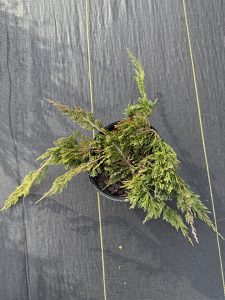
 Blue Rug Juniper (Juniperus horizontalis ‘Wiltonii’)
The overachiever of the group.
Blue Rug is the flattest of the three — and we mean flat. This thing hugs the ground like it owes it money. At just 4–6 inches tall but spreading 6–8 feet wide, it’s basically a living carpet that never needs vacuuming. Its foliage is a striking steel-blue that deepens to a beautiful plum-purple in winter, which is more than most plants do for your garden during the cold months.
Blue Rug is also the hardiest of the trio, tolerating zones 3–9 with the stoicism of someone who grew up in Minnesota and thinks 20°F is “a little chilly.” It laughs at poor soil, drought, heat, and slopes. Got an ugly hillside? Blue Rug will cover it without complaint.
Best for: Slopes, erosion control, rock gardens, and anyone who wants a plant that says “I have my life together.”
Quirk: It’s so flat that debris and leaves can collect in it, which can look a little messy. But honestly, same.
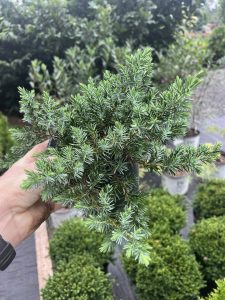
 Blue Pacific Juniper (Juniperus conferta ‘Blue Pacific’)
The beach bum of the bunch.
Blue Pacific is the only one of these three that originates from a coastal species, and it shows. Juniperus conferta is native to Japan’s rocky shorelines, which means Blue Pacific has an almost supernatural tolerance for salt spray, sandy soil, and humidity. If your garden is anywhere near the coast, this juniper was practically born for you.
It grows a bit taller than Blue Rug — reaching 12–18 inches — and spreads 6–8 feet wide with a softer, slightly more billowy texture. The foliage is a fresh blue-green, and unlike its siblings, it holds that color reasonably well through winter without going too purple. It’s the most lush-looking of the three, which makes it great for creating that “effortlessly tropical but still very much a conifer” vibe.
Blue Pacific is hardy in zones 5–9, so it’s not quite as cold-tough as Blue Rug, but it makes up for that with its coastal superpowers.
Best for: Coastal gardens, sandy soils, humid climates, and people who put “former beach volleyball player” in their bio.
Quirk: Prefers better drainage than most of us have in WNC- if you plant this one, be sure to amend the clay with soil conditioner.
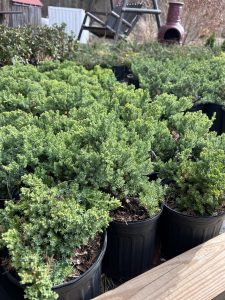
 Procumbens Nana Juniper (Juniperus procumbens ‘Nana’)
The overachiever in miniature. The bonsai darling. The one with the fan club.
Don’t let the “Nana” fool you — this isn’t your grandmother’s juniper (though she’d probably love it). Procumbens Nana is the most compact of the three, growing 8–12 inches tall and spreading 4–6 feet wide, with a mounding, layered habit that gives it incredible visual texture. Where Blue Rug lies flat and Blue Pacific billows gently, Procumbens Nana has structure. It builds up in tiers, almost like a tiny mountain range of foliage.
Its color is a rich blue-green, and it’s a total standout in containers, rock gardens, and — famously — bonsai. Yes, this juniper is one of the most popular species for bonsai training in the world, which means there’s an entire community of extremely devoted people who are very serious about this plant. You’ve been warned.
Hardy in zones 4–9, it’s tough but not as extreme as Blue Rug. It’s also the slowest grower of the three, which is either a pro or con depending on how patient you are.
Best for: Rock gardens, containers, bonsai, Asian-inspired landscapes, and people who appreciate fine craftsmanship in plant form.
Quirk: That slow growth means it takes a few years to fill in. Consider it delayed gratification.
The Head-to-Head Cheat Sheet
| |Blue Rug |Blue Pacific |Procumbens Nana |
|——————–|——–
|**Height** |4–6” |12–18” |8–12” |
|**Spread** |6–8’ |6–8’ |4–6’ |
|**Hardiness** |Zones 3–9 |Zones 5–9 |Zones 4–9 |
|**Color** |Steel blue (purple in winter)|Blue-green |Blue-green |
|**Best feature** |Flattest, toughest |Salt & humidity tolerant|Texture & structure|
|**Growth rate** |Moderate |Moderate |Slow |
|**Bonsai potential**|Low |Low |Extremely high |
So, Which One Should You Plant?
Here’s the cheat code: pick based on your problem, not your preference.
Got a tough slope, extreme winters, or really bad soil? Blue Rug. It will outlast everything else in your yard, possibly including you.
Love blue and want a little more height and less common than Blue Rug? Blue Pacific.
Want texture, drama, and maybe a new hobby that involves tiny pots and contemplative silence? Procumbens Nana. Your rock garden (and your inner bonsai artist) will thank you.
The good news is that all three are drought-tolerant, deer-resistant, low-maintenance, and genuinely beautiful in the right setting. They’re the rare plants that ask very little and give a lot — which, if you ask us, is the best kind of garden companion.
Our Pick For Western North Carolina Gardens: Procumbens Nana, Hands Down
Just in case you’re wondering where we land on this debate — for Western North Carolina gardens specifically, we keep coming back to Procumbens Nana as our favorite. Beyond its great texture and toughness in our mountain climate, it’s simply one of the best groundcovers we know of for suppressing weeds. That dense, layered growth smothers out competition in a way the flatter Blue Rug just can’t match, and unlike mulch, it doesn’t need refreshing every spring. Plant it once, let it settle in, and watch it do the weeding for you. In our book, that’s worth every penny.
Now go buy one. Or all three. We’re not judging.