Every once in a while a plant comes along that earns a permanent spot in our recommendations — not because it’s flashy, but because it solves an actual problem.
Kintzley’s Ghost honeysuckle (
Lonicera reticulata ‘Kintzley’s Ghost’) is one of those plants. If you’ve ever wanted the romance of a flowering vine on a trellis or arbor without unleashing the green monster that is Japanese honeysuckle, this is the answer.
The “Ghost” That Glows for Six Months
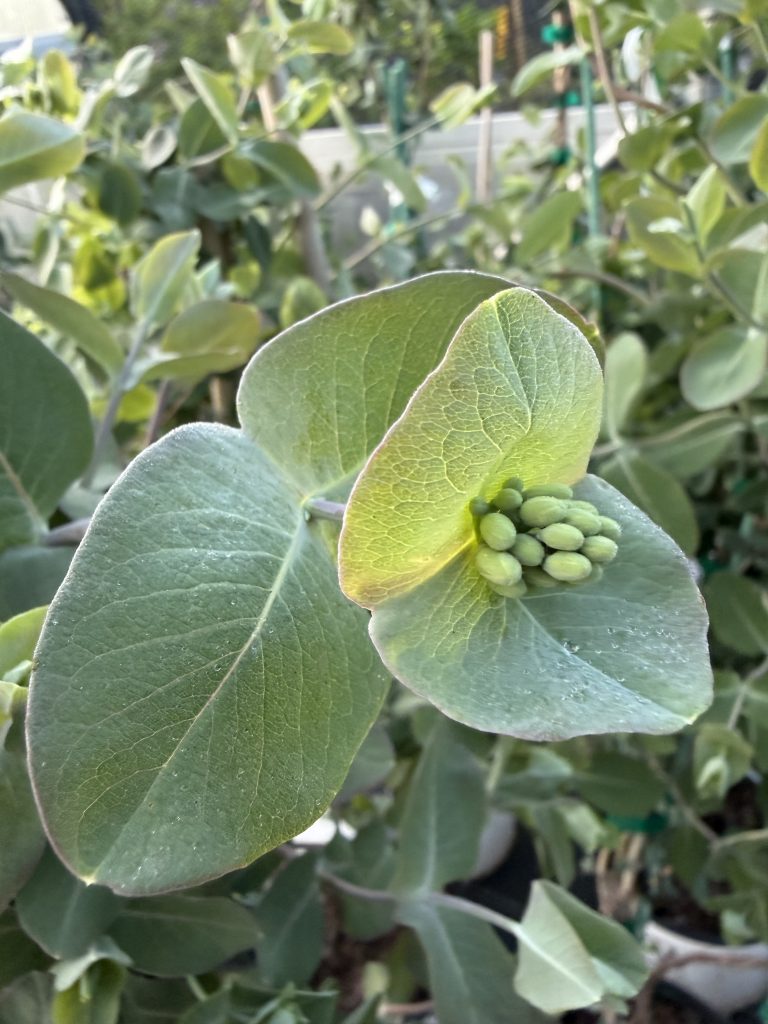
The name comes from the silvery-blue, eucalyptus-like bracts that wrap around each cluster of yellow flowers. The bracts look like little round pewter coins, almost frosted, and unlike the flowers themselves, they don’t fade. The yellow blooms put on a fragrant show in late May and June, but the silvery bracts hang on from spring through late fall — a soft, ghostly glow that catches the light all season. We don’t know of another vine that gives you six months of ornamental interest from a single feature.
The Honeysuckle You’re Allowed to Love
Here in Western North Carolina, Japanese honeysuckle (
Lonicera japonica) is one of the worst invasive plants we deal with. It smothers native shrubs, climbs trees, and outcompetes our wildflowers. A lot of WNC gardeners have learned the hard way to never plant a honeysuckle — and that’s a real loss, because honeysuckles as a group are wonderful for hummingbirds and pollinators.
Kintzley’s Ghost is the rare exception. It’s a selection of
Lonicera reticulata, a Midwestern native species, and it doesn’t set seed aggressively, doesn’t sucker, and doesn’t spread by runners. It stays where you plant it. You get the hummingbirds and the pollinator value without the regret.
How It Behaves in WNC Gardens
This is a vine that thrives in our climate. Hardy from USDA zones 4 through 8, Kintzley’s Ghost handles everything WNC throws at it — late spring frosts, humid summers, the occasional polar vortex. It tolerates our acidic mountain soils without complaint, asks for average drainage, and shrugs off the deer pressure that ruins so many other vines.
- Light: Full sun to part shade (best bloom in 6+ hours of sun)
- Size: 8 to 12 feet tall when climbing; can be allowed to scramble as a groundcover
- Soil: Average, well-drained — tolerates clay if drainage is reasonable
- Water: Average; drought-tolerant once established
- Bloom: Yellow tubular flowers in late spring, followed by red-orange berries in fall
- Wildlife: Hummingbirds, native bees, and butterflies for the flowers; songbirds for the berries
Where to Plant It
Kintzley’s Ghost is a twining vine, which means it climbs by wrapping its stems around supports — it doesn’t cling to walls like ivy. Give it something to grab: an obelisk, an arbor, a trellis, a porch column wrapped in twine, or a length of cattle panel. We’ve also seen it used beautifully sprawling over a low stone wall or letting it scramble along a split-rail fence.
Because of its more restrained habit (you’ll never use the words “restrained” and “Japanese honeysuckle” in the same sentence), it works in smaller gardens and patio spaces where a more vigorous vine would take over. A single plant on an obelisk in a perennial border becomes a focal point for half the year.
A Few Tips for Success
Plant in spring or early fall, keep it watered the first season while the roots establish, and give it a light pruning in late winter to shape and encourage strong new growth. Like most honeysuckles, it can occasionally get powdery mildew in stagnant air — site it where it gets some breeze, and you’ll rarely see it. Mulch with a couple of inches of pine bark or hardwood mulch to keep the roots cool, and skip the heavy fertilizer; this isn’t a plant that wants to be pushed.
The Bottom Line
If you’ve been searching for a flowering vine that earns its keep all season, behaves itself in the garden, and pulls in hummingbirds without getting you on the invasive plant blacklist — Kintzley’s Ghost is the one. It’s a small-batch plant we’re proud to carry, and it always finds the right home.
Stop by Flat Creek Plant Farm to see them in person — they’re looking especially silvery this season.
